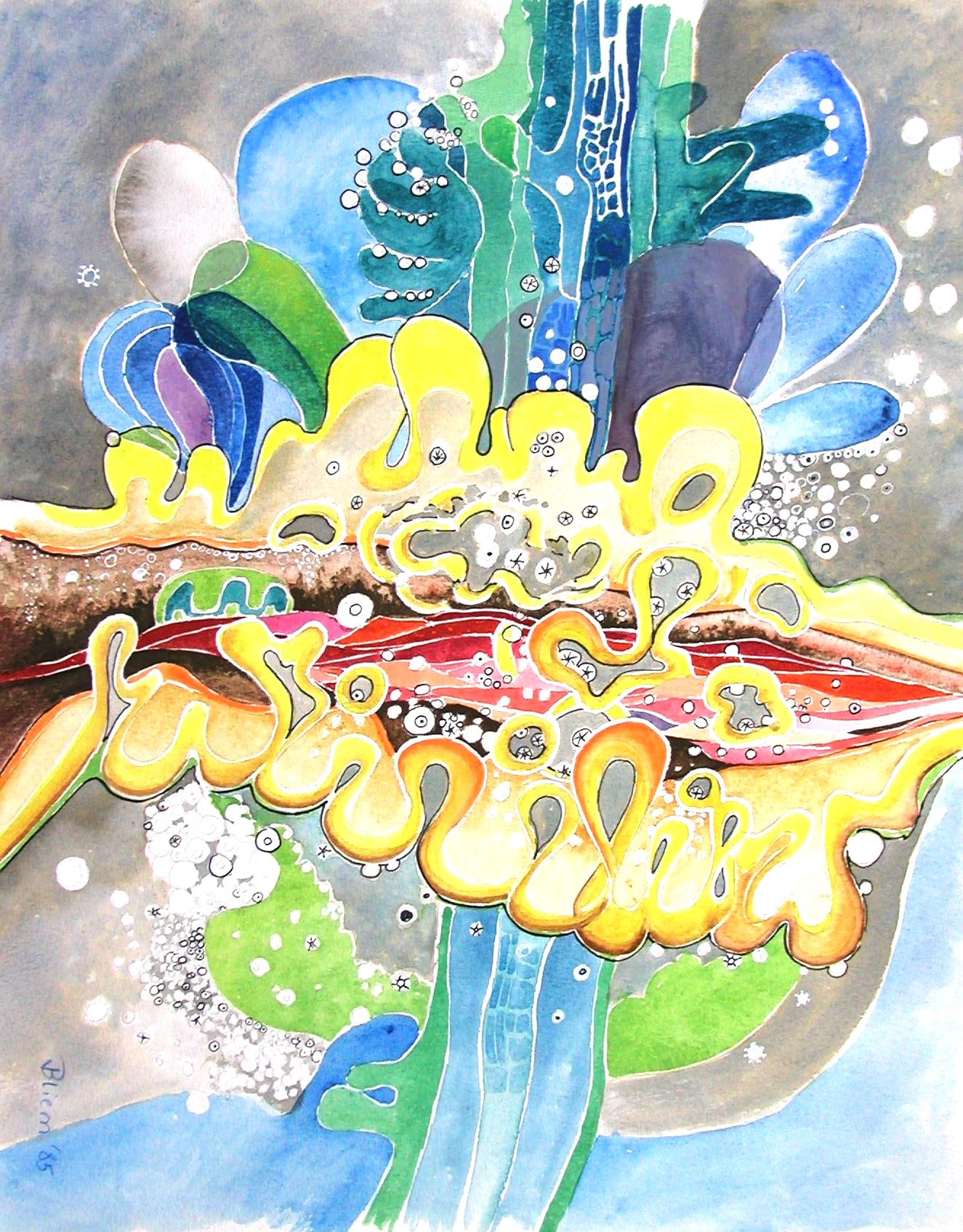
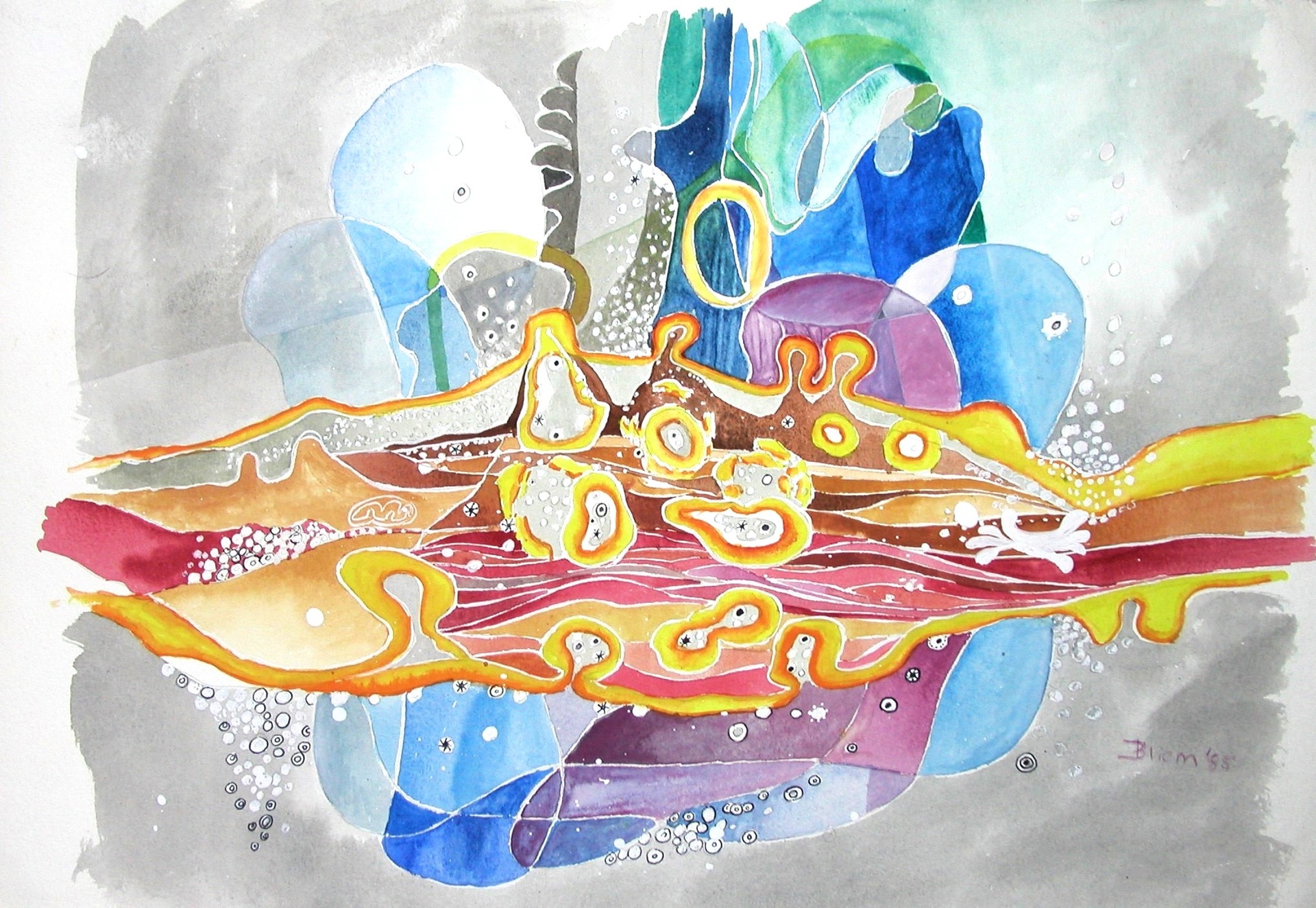
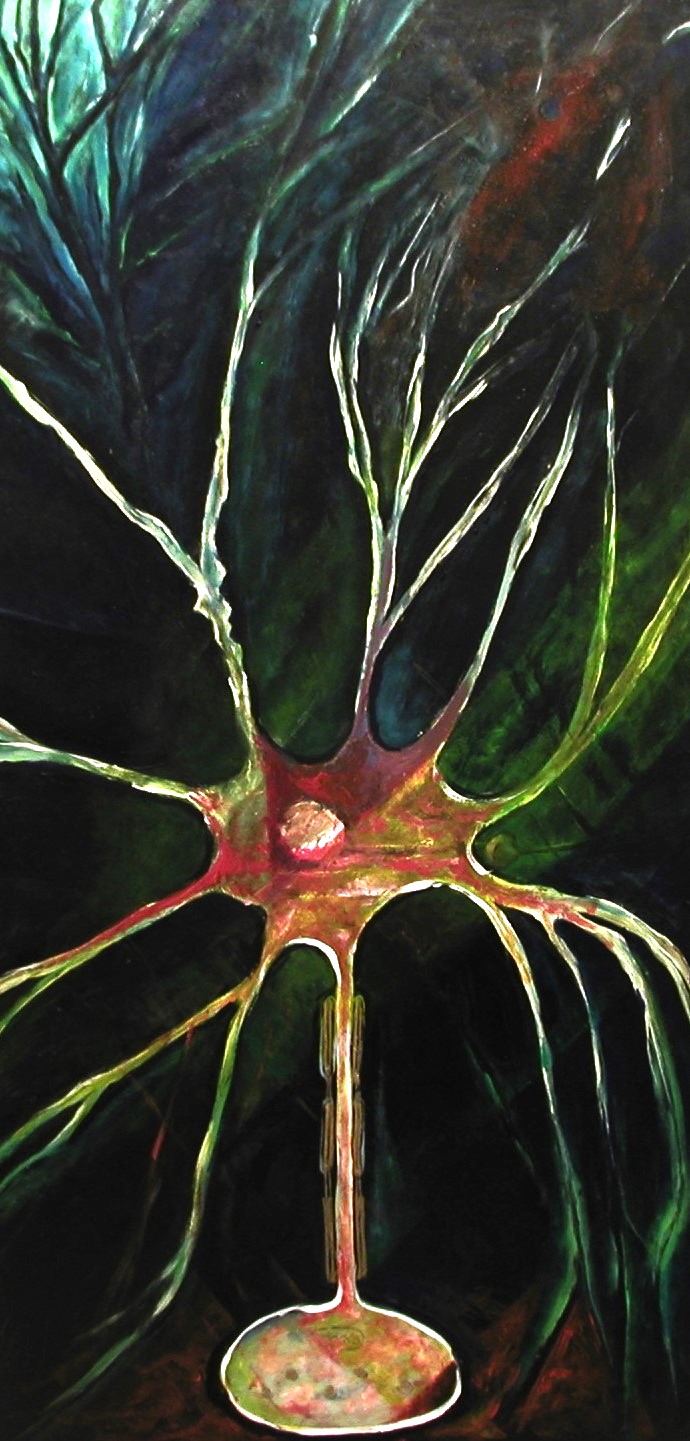
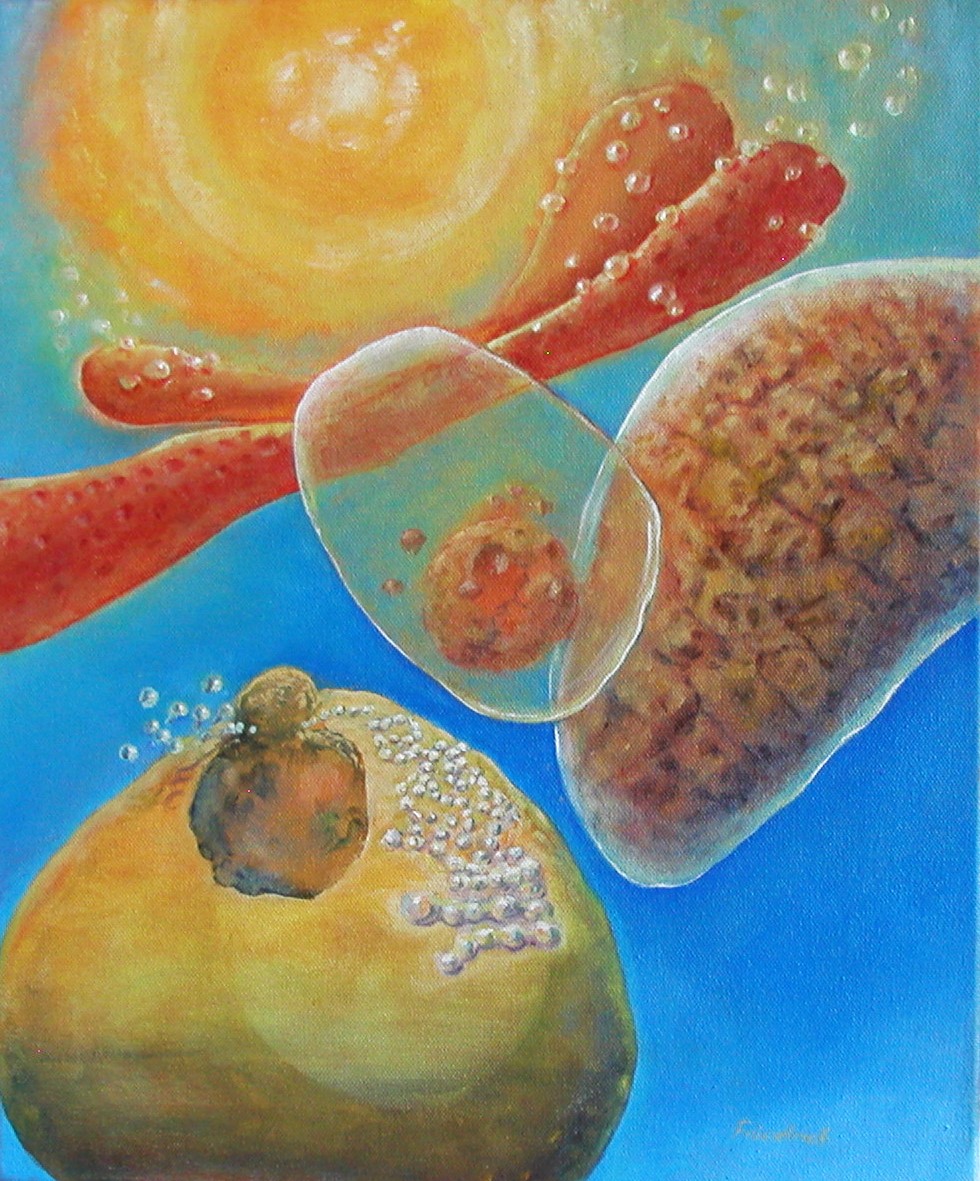
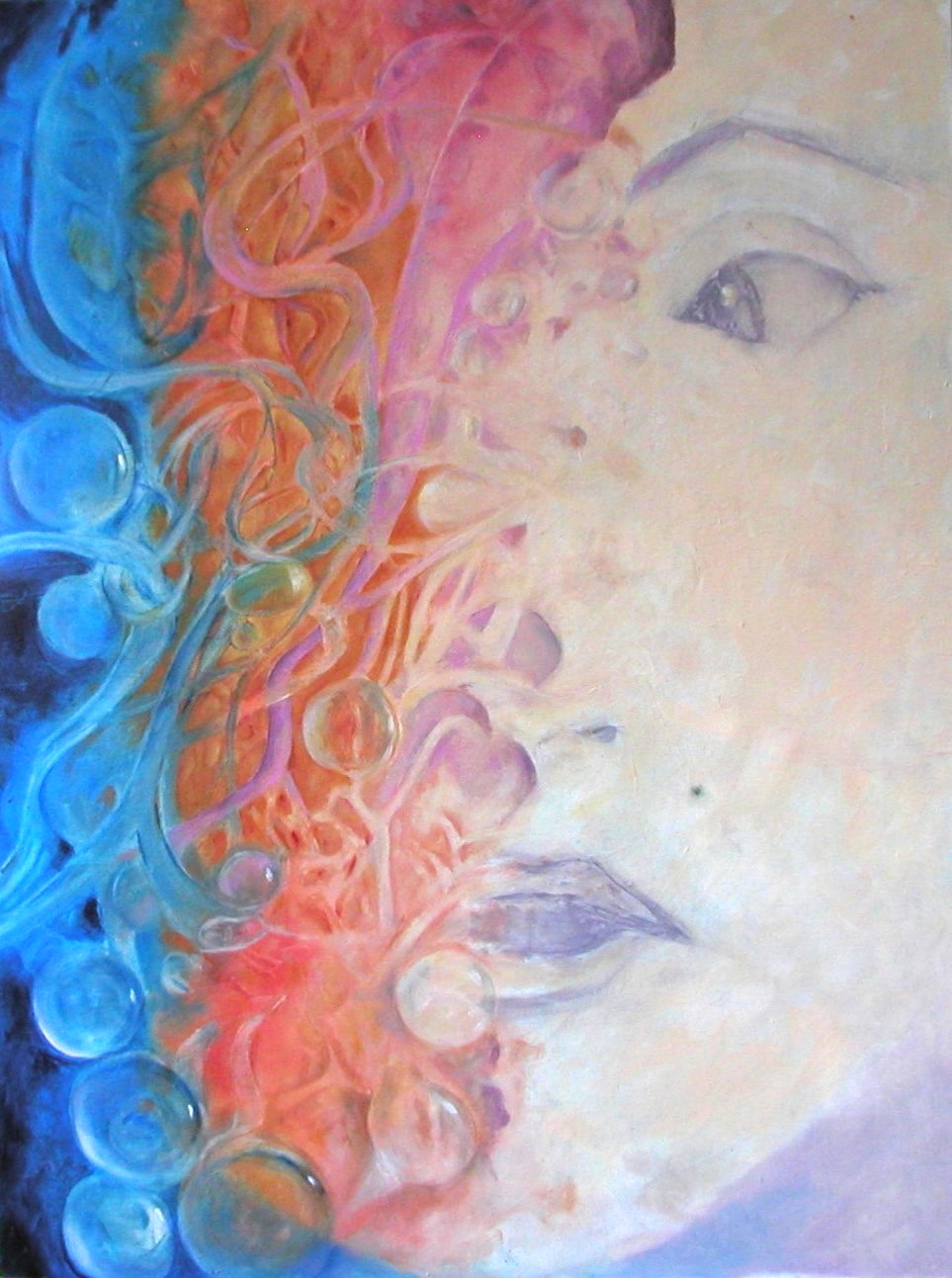
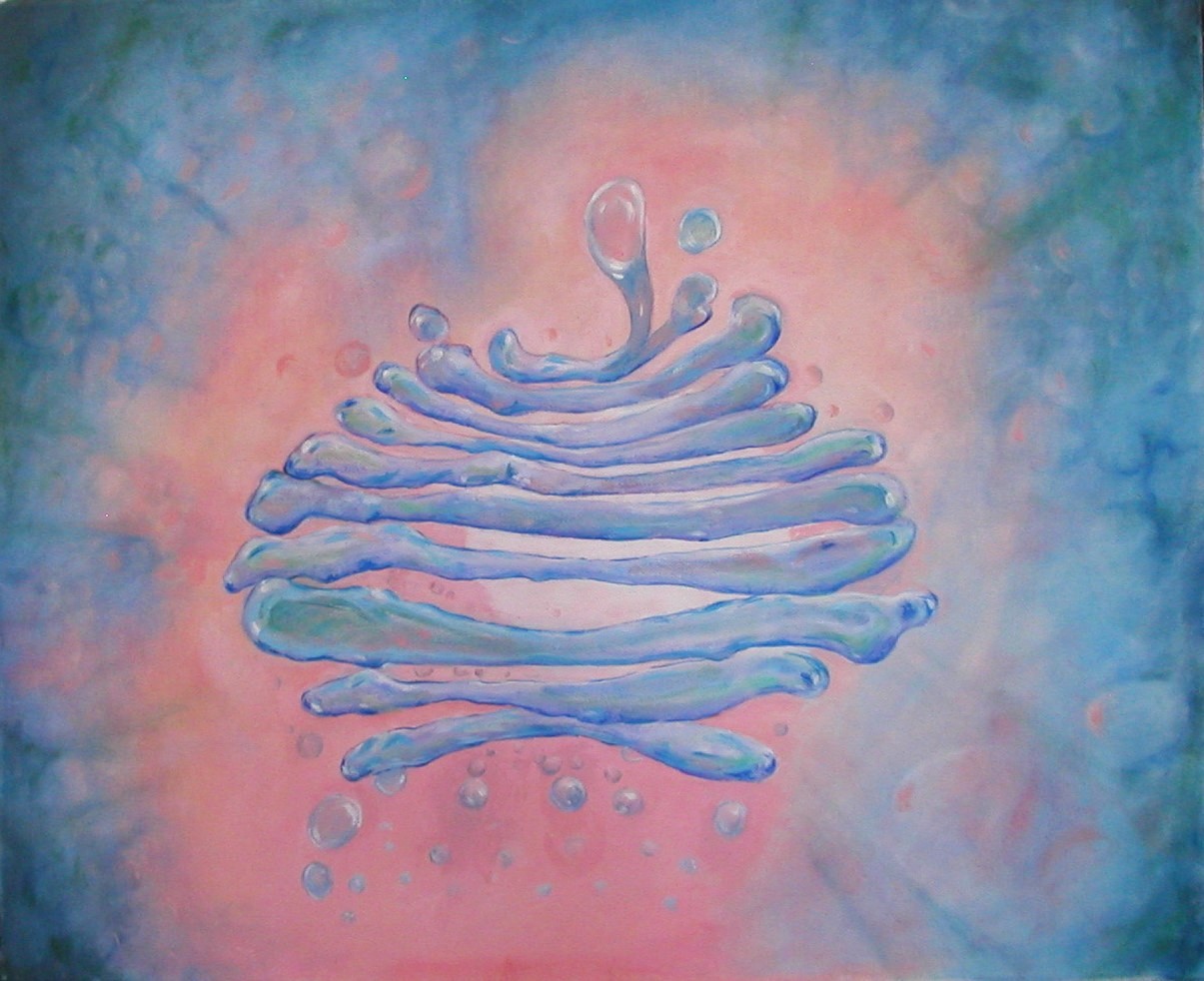
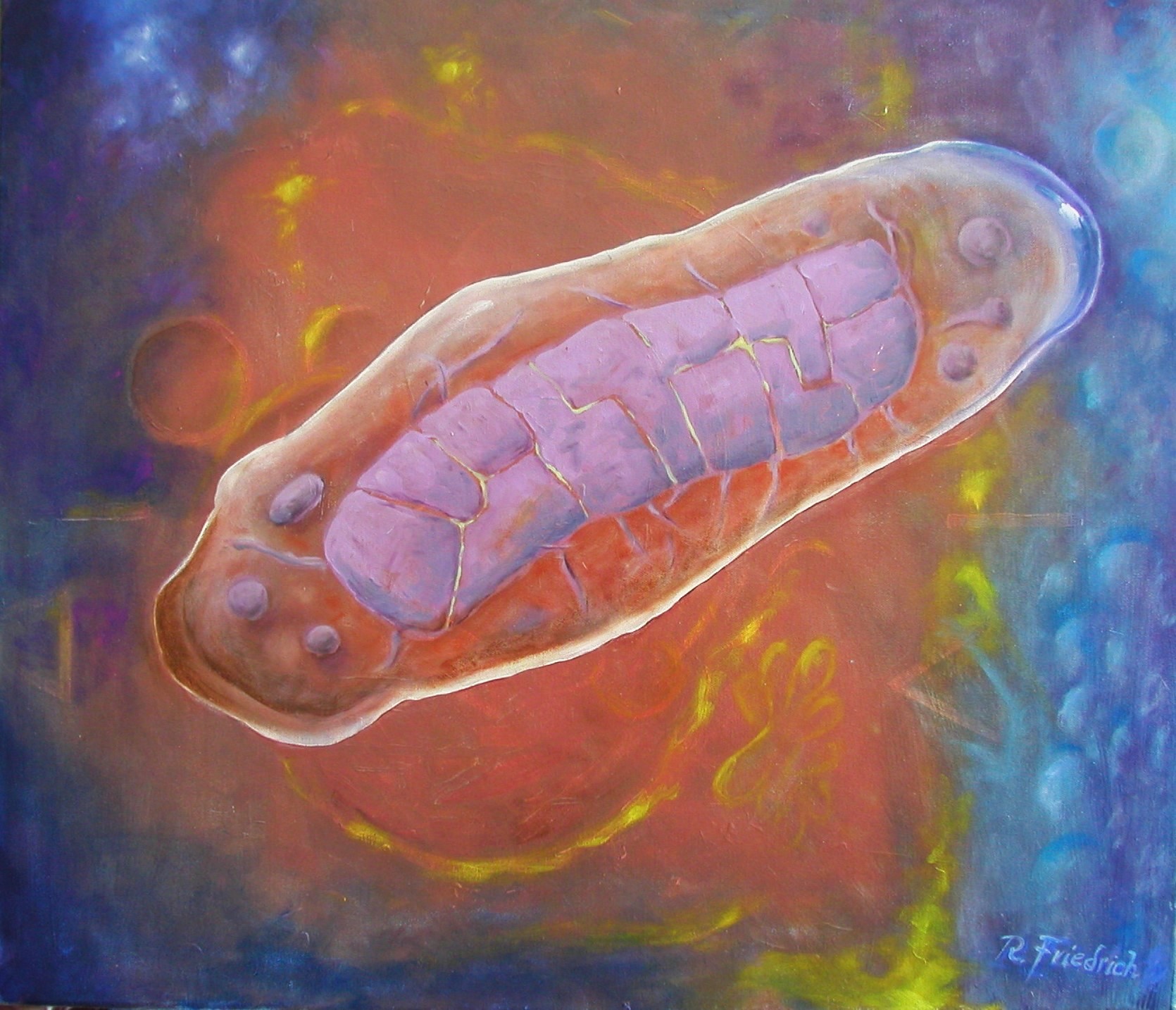
The SciArt movement brings together artists working on scientific themes, scientists using art in their science, and every combination in between, to explore speculative hypotheses and create a comprehensive representation of data. This I exemplified in a solo exhibition in Cambridge, UK, 1984. As such I am a fore runner of the now accelerating SciArt movement.
When observing a scientific image, like one captured by an electron microscope, the image we see is a result of signals generated, when the electron beam interacts with the specimen, providing data, which are in turn converted into an image. We require advanced instruments to visualize the cellular realm although our view is still very limited; as if looking through a small window placed directly on an large object such as a tree. For example, presently our instruments only offer us cross sectional images of cellular subjects or 3D imlimited depth and both only in black and white. The instruments do not provide colour views of the cellular landscape or backdrop. Some lucky shots may capture an aesthetic impression.
Art offers visual representations of aesthetics of the cellular realm that go beyond the limitations of scientific imaging techniques.
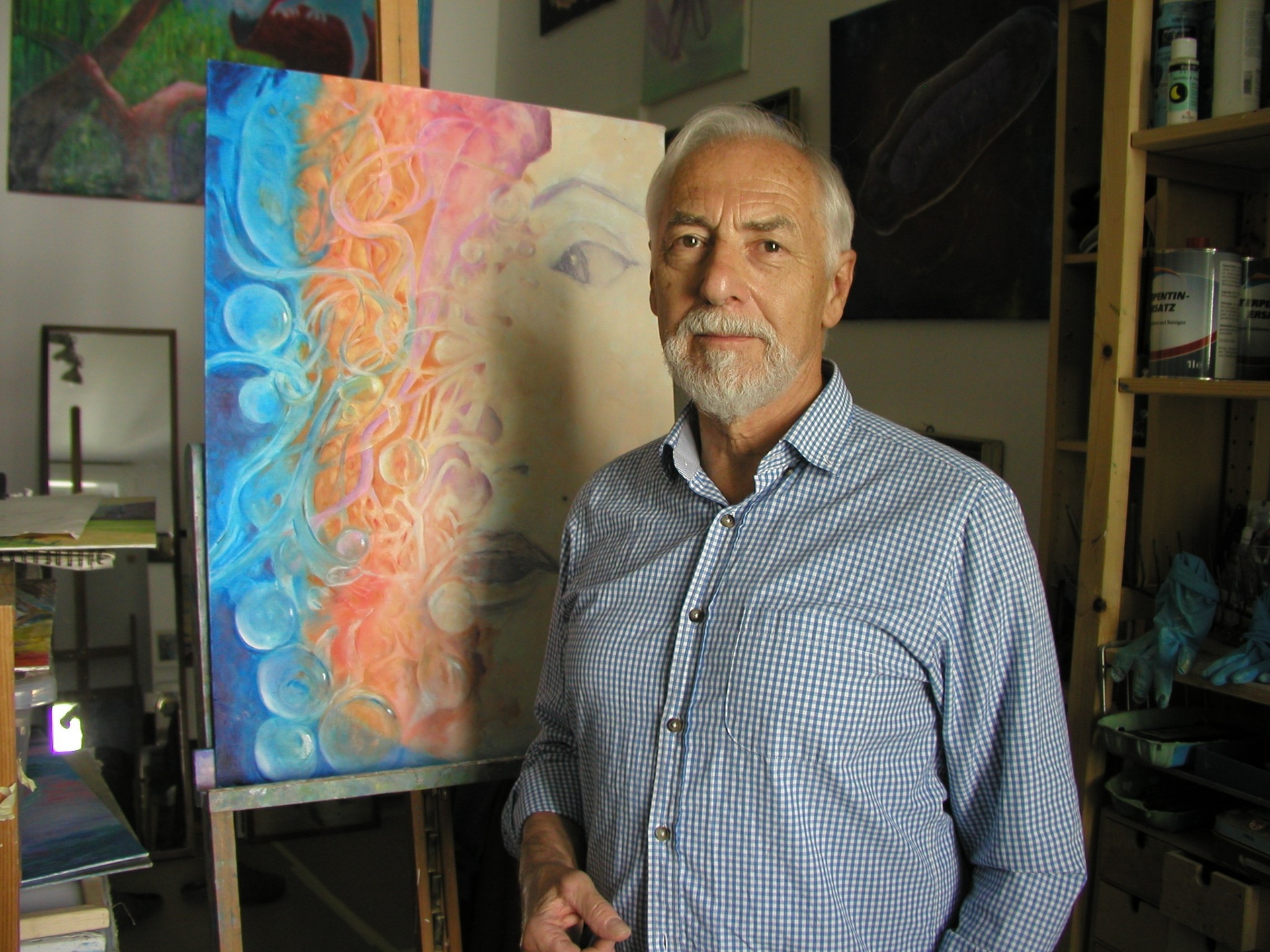
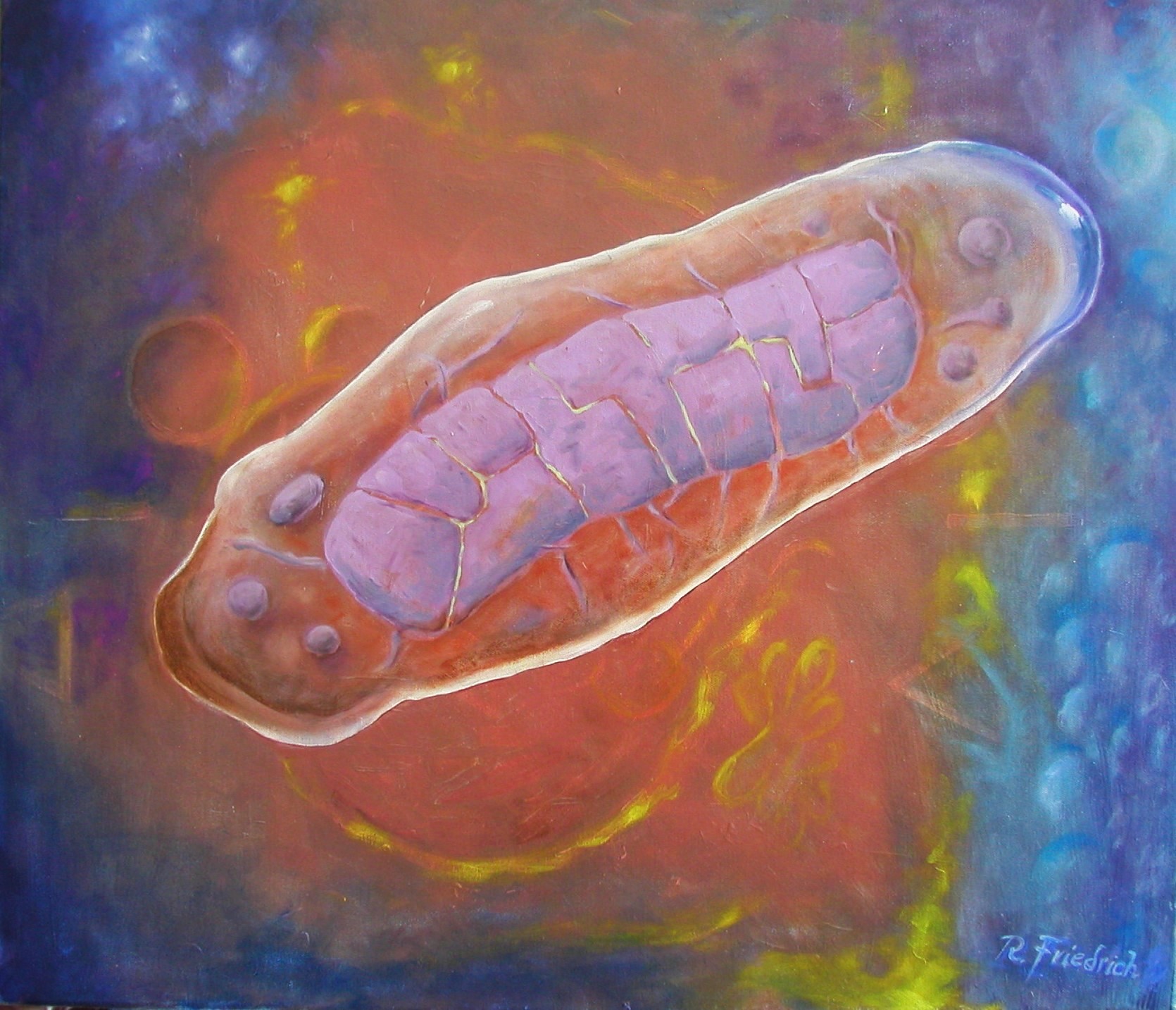
As artist I employ myself as a metaphorical microscope, converting scientific knowledge on cellular properties into an image expessed as a painting. I conceive the composition of a painting by placing myself into the scene or landscape, creating the light to develop the colours. I am able to see a cellular object and backdrop from an entirely different view point, both in terms of perspective, colour and structure. So, by applying the techniques of painting, I am able to create visual representations of cellular structures that go beyond the black-and-white, cross-sectional images typically produced by scientific instruments. The artistic interpretation can add depth, dimension, and symbolic meaning to the scientific data, engaging viewers on multiple levels. And yet my artistic work is much like any scientific investigation in that it involves retrieving information, formulating hypotheses, and using intuition to fill in the gaps, thus arriving at novel image of the cellular environment. And the image evolves in the process just as a hypothesis often gives way to modified form as the results of the scientific inverstigation appear.
By embodying both roles as an artist and a scientist, I implement my visions directly, without the need to bridge a knowledge gap as is typically the case in contract illustrations. However, unlike illustrations, my paintings are not intended to communicate scientific information, nor are they copies of scientific images, be it patterns microbial or physico-chemical reactions. And they are not intended to compare with digital illustrations.
I create cellular structures within an imaginary landscape or space that should hold th viewer, if only for a fleeting moment, evoking an emotion, inspiring a curiosity and leaving an impression of this captivating and fascinating microcosm that makes up our very being. And they are intended to reflect the human hand and imagination from which the visions stem.
Animal moments - "Tierisches"
Animals offer moments in which die common ancestry with humans appears and, watched closely it is as if this were the original, somewhat childlike feature that humans leave behind as they grow out of childhood. But unlike with humans, this feature appears simpler and is best expressed in some brief and comic moments. It is this human nature in animals that not only offers humor, but also, in curious way, lets me once again believe in humanism.
My paintings reflect such moments, which are taken from nature, sometimes by personal observation, sometimes by someone elses observation captured in a fotograph.
The human in the animal is but one aspect of the animal sujets. In the other aspect I seek to capture the animal reduced to its essential idiosyncratic features, those necessary to clearly identify the animal, but no more; typically referred to as the "essence of the the animal."
It is a fascinating area of study, which constantly keeps me on the look out for such animal moments, which, when identified, often draw a smile, but also a sence of satisfaction.
Other subject matter
Other sujets are either prepared for a particular project, for example series on tango argentino. Or simple as subjects inspired by a street scene or visit to a museum. These are exclusively realistic, either naturalistic or realistic with an expressionistic touch.
Artistic technique
Materials
Having previously worked in watercolours, acrylic, wax and oils, in the last few years I have worked exclusively in oils, both on board and linen.
The sizes of my paintings vary from 30x40 cm to 150x180 cm. Most however are between 50 and 90 cm.
Artistic Style
My paintings may generally be classified as a mix or surrealistic or post-impressionistic with abstract elements. Sci-Art subjects span the greater range from quasi naturrealistic to symbolic, as employed for scientific concepts.
Animal motives are largely post-impressionistic embeded in abstract expressionistic surround.